Time to Call a Coach: Support Over Survival Mode
As leaders, it’s easy to feel like you have to do it all on your own; that you are required to be strong and unflappable. This probably works for you, at least well enough. But what about when it’s too much?
It’s the end of the fiscal year, and you’re making sure your reporting is ready to go and all the numbers add up. You just launched a new product last month. One of your team members just put in their two-week notice. Everything is piling up.
Is it time to call for help? Truthfully, in the ideal world, you’ll never want help until it’s too late, but how do you know when it’s time?
The Time Is Now!
Global engagement is sitting at a low of 20%. This isn’t “things could be better” — this is the lowest point in nearly ten years. Gallup’s research indicates that a large share of the engagement is attributed to managers. This means that the managers are the ones determining whether a team is engaged, not the perks, pay, or remote work policy.
That's not a knock on managers — it's a knock on the support they've been given. Under half of managers around the world — 44% — have ever received formal management training. A lot of people leading teams are doing it without ever learning what it takes to lead them well.
This is a positive signal, too: it means investing in leadership development could meaningfully improve the modern workplace. But it's not a one-off training session or workshop that does it — it's a meaningful relationship between a leader and a coach, over time.
The data makes the case for coaching in general. But you're not a statistic — you're a person staring down a fiscal year close, a product launch, and a team member's exit notice, all in the same week or month. So let's get specific. Here's how you know it’s time to call a coach.
You keep solving the same problems. Whether it’s a different quarter, a different project, or a different objective, if the same problems keep popping up, it’s worth stepping back. The repetition isn’t a sign that you’re failing or a bad leader, but it is a sign that there’s something structural in your leadership style that might be the root cause.
You’re wearing bigger boots than you’re ready for. A new role with new responsibilities is often a welcome opportunity, but the skills that made you good at your old position may not translate 100%, or they just aren’t enough to be successful in this new role.
You’re not in tune with everything going on. Your peers are busy with their own roles. Your direct reports aren’t pushing back. You only talk to the board once a quarter. If you can't remember the last time someone challenged your thinking, that's not confidence — that's isolation.
Everyone’s agreeing with you, but the needle isn’t moving. Heads are nodding in meetings, but results have stalled. The gap between harmony and KPIs is a strong signal that something is off.
Your stress is constant. Nothing is glaringly wrong, but stress is steadily lingering. It’s not just a bad quarter — it’s every quarter, and it’s impacting your life outside of work, too.
Look back at that chaotic moment we talked about at the beginning. The fiscal year is closing, you’re launching a new product, and there’s a resignation letter on your desk. Maybe none of those things feel like your fault… yet. But maybe one of them does. Maybe you’ve found yourself having these coinciding challenges a few times in recent years. Maybe your new promotion is asking you to do things you’ve never done before. Maybe you don’t remember the last time someone gave you good feedback.
You don’t need to check all these boxes, but if one of them is really ringing true, it might be time to be honest with yourself and call for help. If you ignore it, it may just compound.
The strongest leaders don’t wait for a fire to start. They bring in support when they notice some things are falling behind, while others are still running. That’s the right time for a coach.
The leaders who get the most out of coaching are rarely in crisis mode. They’re the ones who noticed the signs early and didn’t wait for a worse quarter or another resignation. The payoff from coaching isn’t just a one-time fix for your current team, this year. Managers who go through real, ongoing coaching see their performance improve up to 28%, and it lasts — sometimes even 9 to 18 months of sustained difference, not a temporary high or burst in energy.
The cost of waiting to bring in a coach is much higher than harm to the business - it’s harm to yourself. If you ignore the warning signs, you’re more likely to burn out and leave, whether it’s just this organization, or it’s a bigger, life-altering career break.
But What Does Coaching Look Like? What Does It Really Give You?
You've probably sat through a "leadership workshop" before — same slides, same ten steps, no idea who's in the room. This isn't that.
Coaching is reframing how you think and strengthening the things that landed you a leadership role in the first place. It’s having someone on your side that asks you the hard questions you don’t have time to ask yourself, and they don’t just tell you what you want to hear.
Let’s go back to that tough week or month one more time. The reporting. The launch. The resignation letter. Now imagine that you saw the warning signs and called for help six months prior. You noticed things were changing, but not yet falling apart.
That's the leader you can be with the help of a coach. Not someone who never has a bad quarter — someone who doesn't carry it alone.
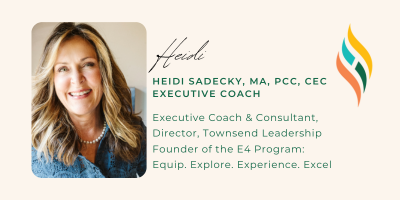
If you saw yourself anywhere in this article, that's worth paying attention to. This is the work I do one-on-one with leaders — an ongoing relationship built around what you're facing right now, not a one-time session. If any part of this felt like it was written about your week, let's talk. And if you're ready for a deeper, structured journey alongside other leaders, E4 and the Townsend Leadership Program are there, too.
Let's figure out what's next. Contact me today.